



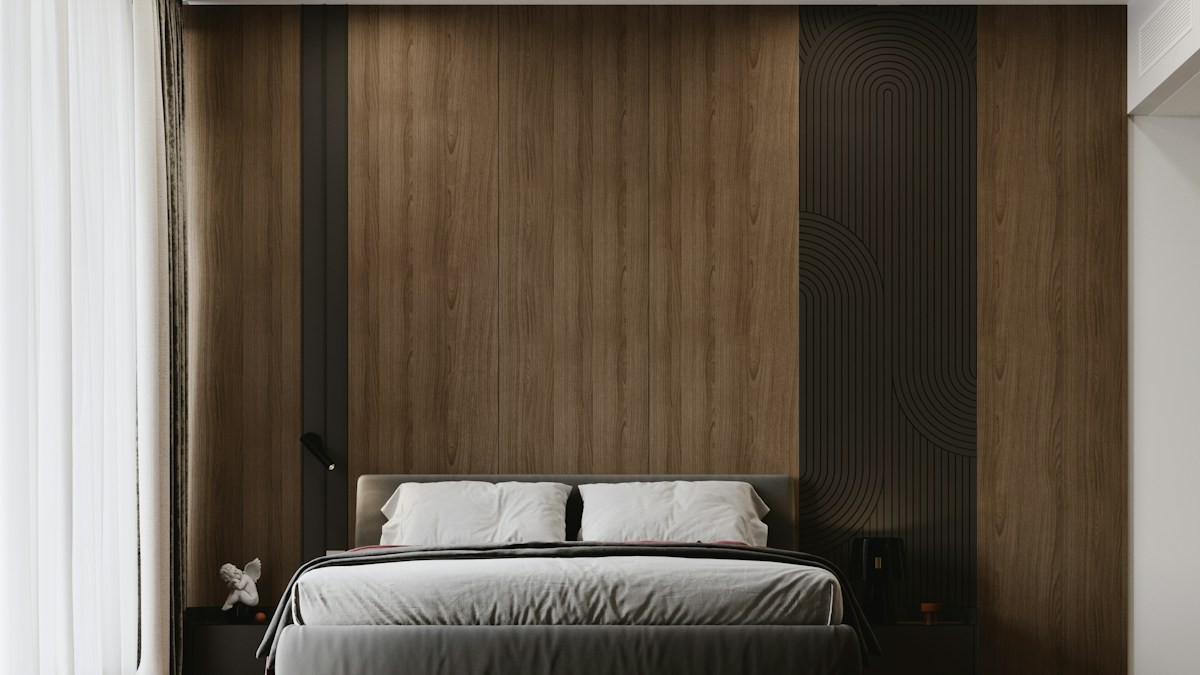
In modern interior architecture and luxury boutique hotel design, the bedroom headboard is undergoing a dramatic structural evolution. Traditional bulky headboards with floor-standing wooden legs, bulky corner posts, and matching floor nightstands consume substantial floor area, create awkward dust-trapping crevices, and visually overwhelm compact bedrooms. The modern design vanguard has embraced the floating headboard—a wall-mounted architectural statement that appears to hover effortlessly above the floor.
When paired with concealed warm LED backlighting and integrated cantilevered floating bedside ledges, a floating headboard accomplishes a triple design victory: it provides comfortable upright back support for reading, eliminates the need for floor nightstands entirely, and bathes the bedroom in a soothing, indirect architectural halo glow that promotes circadian relaxation.
This comprehensive woodworking and electrical guide details the fabrication of floating headboards concealed led systems. You will master the physics of heavy-duty French cleat wall mounting, learn how to recess aluminum LED channels with frosted diffusers for spotless illumination, and integrate hidden wireless charging hardware that banishes bedside clutter forever.
The Mechanics of the French Cleat: Heavy-Duty Wall Anchoring
Why 45-degree interlocking wooden cleats are the gold standard for floating furniture.
The 45-Degree Bevel Interlocking Geometry
A French cleat is a centuries-old joinery system consisting of two matching wooden rails cut lengthwise at a precise 45-degree bevel angle. One rail (the wall cleat) is secured horizontally to the wall with the 45-degree bevel sloping upward and inward toward the drywall.
The matching rail (the object cleat) is fastened to the back of the floating headboard with its bevel sloping downward and outward. When the headboard is lifted and lowered onto the wall cleat, the two opposing bevels slide together, using the natural downward pull of gravity to clamp the headboard tight and flush against the wall.
Stud Anchoring and Load Capacity Calculations
Never rely on hollow drywall anchors to hang a heavy headboard. A quality floating headboard crafted from hardwood plywood, acoustic foam, and upholstery can weigh between 50 and 90 pounds. When an adult leans back against it to read in bed, dynamic horizontal forces multiply.
Fabricate cleats from high-density 3/4-inch Baltic birch plywood. Fasten the wall cleat directly into at least three structural wall framing studs using heavy 3-inch GRK structural screws or lag bolts with washers. This interlocking connection easily supports over 300 pounds of vertical and lateral force with zero risk of detachment.
Concealed LED Halo Backlighting: Optics, Kelvin, and Diffusion
Designing spotless architectural backlighting that enhances circadian rhythms.
COB (Chip-on-Board) LEDs vs Standard Diode Strips
Standard budget LED tape features individual surface-mounted diodes (SMDs) spaced half an inch apart. When mounted near a wall, these individual diodes cast ugly, distracting circular ‘hotspots’ or dotted lines across the paint.
For luxurious, seamless architectural lighting, strictly utilize modern Chip-on-Board (COB) LED strips. COB technology packs hundreds of microscopic LED chips beneath a continuous phosphor coating, producing a perfectly uniform, unbroken ribbon of liquid light with zero visible dots.
45-Degree Aluminum Extrusions with Opal Diffusers
Never stick bare LED tape directly to wood; LEDs generate heat that degrades adhesive over time. Mount the COB strip inside an angled 45-degree corner aluminum channel extrusion equipped with a frosted milky opal polycarbonate diffuser lens.
Recess the aluminum channel into the rear perimeter of the headboard, positioned approximately 2 to 3 inches inward from the outer edge. The 45-degree angle casts the light outward and backward onto the wall drywall, creating a gorgeous, indirect floating halo that glows softly without shining directly into your eyes.
Nightstand Elimination: Integrated Cantilevered Ledges and Tech Integration
Reclaiming 100% of bedroom floor space around the bed.
Cantilevered Floating Bedside Shelves
Traditional bedside tables occupy at least 4 to 6 square feet of floor space on either side of the bed. By extending the width of your floating headboard beyond the mattress boundaries, you can integrate cantilevered floating shelves that project horizontally directly from the headboard face.
Crafted from 1-inch solid white oak or walnut, a 14×10-inch floating shelf provides ample room for a book, glasses, and a water glass while leaving the floor beneath completely open. This dramatically expands perceived room size and allows robotic vacuums to clean unencumbered.
Concealed Qi Wireless Charging and Pop-Up Power
Banish messy, tangled charging cables from your bedside. Route a shallow circular pocket into the underside of your wooden floating shelf using a plunge router, leaving a thin 1/8-inch veneer on the top surface. Glue an invisible, long-range Qi wireless charging puck directly inside the routed cavity from below.
When you set your smartphone on the bare wooden shelf at night, it charges magically through the solid wood! Route all power wires through the hollow cavity behind the headboard to a single wall outlet for an immaculate, cord-free sanctuary.
Floating Headboard Materials & Dimension Specifications
| Component Part | Ideal Material / Gauge | Dimension Standards | Architectural Function |
|---|---|---|---|
| Main Headboard Panel | 3/4″ Baltic Birch Plywood | Mattress Width + 24″ (Extended) | Structural core for shelves & upholstery |
| Interlocking French Cleat | 3/4″ Hardwood Plywood (45°) | Length: 80% of headboard width | Supports 300+ lbs, flush gravity lock |
| LED Backlight Channel | Anodized Aluminum 45° Channel | Recessed 2.5″ from outer perimeter | Heat dissipation & seamless diffusion |
| LED Lighting Strip | 24V COB Warm-Dim LED (90+ CRI) | 2200K – 2700K CCT spectrum | Spotless, indirect circadian halo glow |
| Floating Bedside Ledge | 1″ Solid Hardwood (Oak / Walnut) | 14″ Width x 10″ Depth | Replaces bulky floor nightstands |
Recommended Further Reading & Authoritative References
To deepen your practical mastery of these concepts, explore our comprehensive analyses on concealed headboard storage DIY floating shelves and hidden compartments and circadian lighting Kelvin temperatures and evening melatonin secretion. For official technical standards, peer-reviewed benchmarks, and industry guidelines, consult the Family Handyman: Master Guide to Building Heavy-Duty French Cleats.
Advanced Implementation Strategies and Field Best Practices for Floating Headboards Concealed Led
When implementing these methods in real-world scenarios, consistency and continuous observation serve as the primary determinants of long-term success. Experienced practitioners recognize that theoretical frameworks must be adjusted to account for subtle environmental variables, microclimate fluctuations, and individual behavioral variations. Establishing a disciplined monitoring log allows you to identify subtle trend shifts early, long before minor discrepancies escalate into systemic issues.
Furthermore, avoiding common beginner pitfalls requires a firm adherence to validated core principles rather than adopting transient shortcuts or unverified commercial gimmicks. Integrating periodic structural audits—whether assessing substrate integrity, water chemistry equilibrium, physical mechanical wear, or nutritional bioavailability—guarantees that every safeguard remains fully operational. By prioritizing holistic wellbeing and systematic execution, you establish an environment of enduring stability, resilience, and superior measurable outcomes.
Frequently Asked Questions
Will a floating headboard rattle or hit the wall when someone moves in bed?
No! Because the 45-degree French cleat uses the downward pull of gravity to draw the headboard tightly against the wall, it cannot wobble. For added silence, stick small rubber or felt bumper pads along the bottom rear edge of the headboard.
How high above the mattress should a floating headboard hang?
Position the bottom of the floating headboard approximately 2 to 4 inches below the top surface of your mattress. This conceals the wall gap completely, preventing pillows from slipping behind the bed.
Can I upholster a floating headboard with fabric and foam?
Yes! Layer 2-inch high-density upholstery foam over the plywood base, wrap with polyester batting, and stretch your chosen fabric (linen, velvet, or boucle) tightly around to the back, securing with heavy staples before mounting the French cleat.
Where do I hide the bulky LED power supply transformer?
Mount the low-profile 24V LED power driver inside the hollow recess on the back of the headboard, between the French cleats. A small, discrete cord can plug into the existing wall outlet behind the mattress.