



For hundreds of thousands of years, human biology evolved in direct synchrony with the natural solar photoperiod. Our ancestors woke to the dynamic, blue-enriched spectral dawn of the sun, spent their days under bright 10,000-lux skies, and wound down in the evening illuminated solely by the warm, amber flicker of wood fires and candlelight. In our modern electrified society, however, this primordial biological clock has been violently disrupted by artificial solid-state LED illumination and glowing electronic screens.
In 2002, neuroscientists made a revolutionary discovery that fundamentally altered sleep medicine: the human eye contains a specialized class of non-visual photoreceptors known as intrinsically photosensitive retinal ganglion cells (ipRGCs). These cells do not contribute to visual image formation; instead, they project directly to the brain’s master biological clock—the suprachiasmatic nucleus (SCN)—regulating the daily synthesis of melatonin, cortisol, and body temperature. When exposed to bright, high-Kelvin artificial light after dusk, the SCN is tricked into believing it is midday, abruptly halting melatonin secretion.
This comprehensive chronobiology manual details the science of circadian lighting kelvin melatonin dynamics. We analyze the photobiology of melanopic lux, decode the Kelvin color temperature spectrum, evaluate warm-dimming LED driver technology, and provide an actionable architectural lighting blueprint that transforms your bedroom into an organic melatonin-friendly sanctuary.
The Neurobiology of Retinal ipRGCs and Melatonin Suppression
Why 460-480nm wavelengths act as a neurological stimulant.
Melanopsin Photopigments and the Circadian Pathway
Unlike rods and cones that process shapes and colors, ipRGCs express a unique photopigment called melanopsin. Melanopsin exhibits peak sensitivity to a narrow band of blue-cyan wavelengths centered specifically between 460 and 480 nanometers.
When photons in this narrow spectral window hit the retina, ipRGCs fire continuous electrical action potentials along the retinohypothalamic tract directly into the suprachiasmatic nucleus. The SCN immediately signals the pineal gland to halt the enzymatic conversion of serotonin into melatonin—the master hormone responsible for lowering blood pressure, core temperature, and inducing drowsiness.
The Epidemic of Circadian Phase Delays
Exposure to standard 4000K-5000K ‘cool white’ overhead lighting or unshielded smartphone screens in the evening delays endogenous melatonin secretion by an average of 90 to 120 minutes. This induces ‘circadian phase delay’—causing individuals to toss and turn until 1:00 AM while experiencing fragmented, low-quality REM and deep delta sleep.
Over time, chronic evening circadian disruption is clinically linked to metabolic dysregulation, immune suppression, elevated systemic inflammation, and depression.
Decoding the Kelvin Spectrum: From 5000K Daylight to 1800K Candlelight
Understanding correlated color temperature (CCT) and melanopic lux.
High Kelvin vs Low Kelvin Spectral Distribution
Correlated Color Temperature (CCT) is measured in Kelvins (K) and describes the visual hue of emitted light. High CCT light (4000K to 6500K) appears crisp, bluish-white and mimics noon sunlight, featuring colossal spikes in melanopic blue wavelengths designed specifically for daytime alertness.
Low CCT light (1800K to 2700K) shifts the spectral power distribution toward long, warm amber and red wavelengths. Because these warm wavelengths fall completely outside the 460-480nm melanopsin absorption peak, they provide comfortable visual illumination without triggering the SCN’s biological daytime alarm.
Warm-Dimming LED Technology vs Standard Dimmers
Standard budget LED bulbs maintain a fixed Kelvin temperature as they dim; turning down a 3000K bulb simply produces a dimmer 3000K light with the exact same blue-enriched spectral ratio. Modern chronobiological lighting utilizes ‘warm-dimming’ (dim-to-warm) LED drivers.
A warm-dimming bulb dynamically alters its color temperature as it dims: at 100% brightness, it emits a comfortable 2700K soft white, but as you lower the dimmer switch toward 10%, the internal circuitry activates secondary amber diodes, dropping the color temperature down to an intimate 1800K to 2200K that perfectly replicates the spectral warmth of a flickering candle.
Architectural Bedroom Lighting: Lumens, Angles, and Fixture Placement
Designing multi-layered residential lighting for biological wind-down.
Eliminating Recessed Ceiling Cans in the Bedroom
The single worst lighting design for a bedroom is recessed ceiling ‘pot’ lights shining straight down from above. In nature, light from overhead indicates noon sunlight, maximizing retinal exposure across the lower retina where ipRGCs are most densely concentrated.
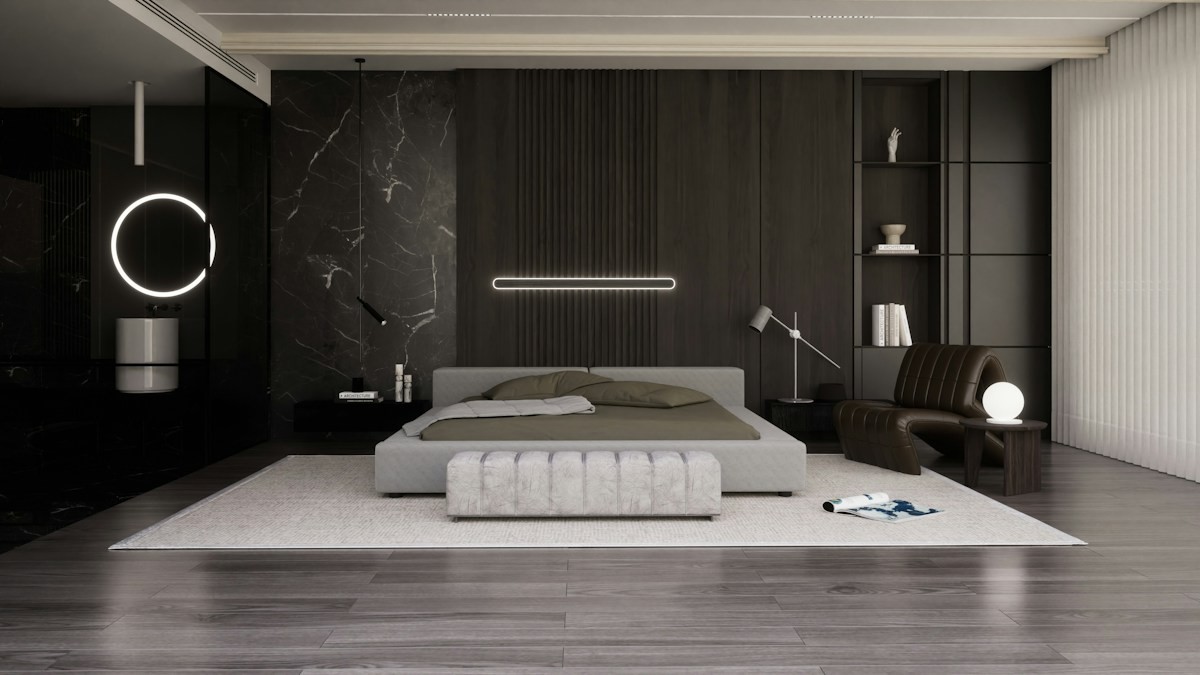
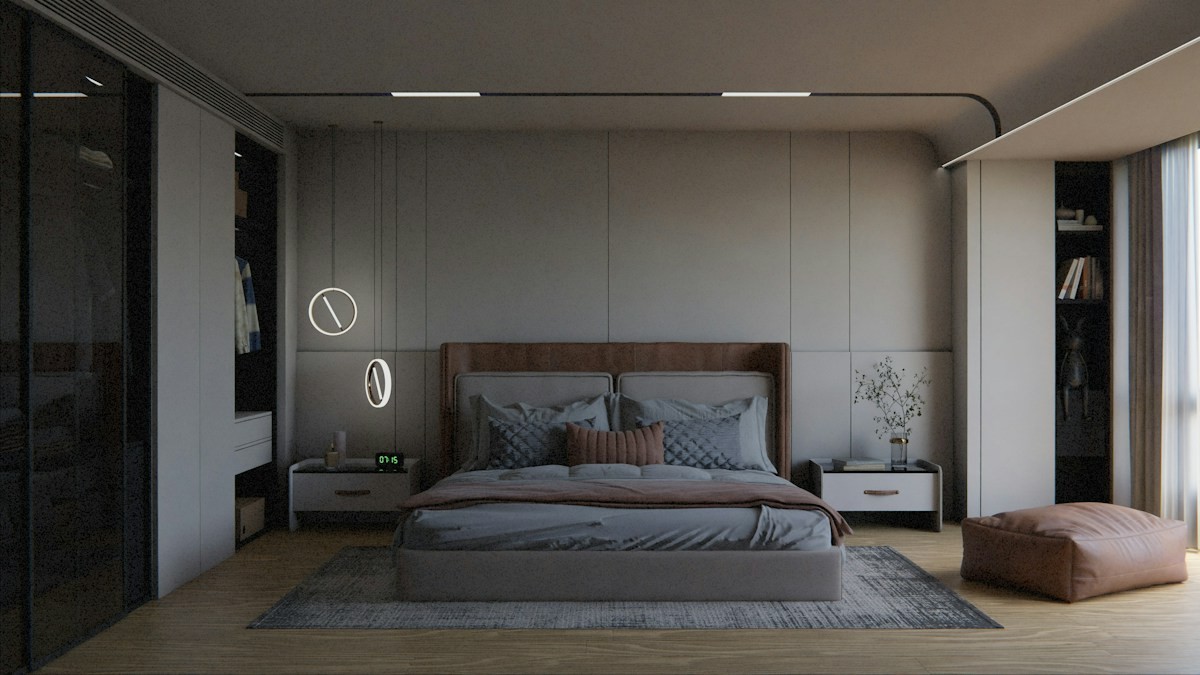
Banish harsh overhead ceiling fixtures in the evening. Instead, design indirect, eye-level and below-eye-level lighting: bedside sconces aimed downward, floor lamps with opaque fabric shades that bounce light softly against walls, and low-level baseboard nightlights.
The Two-Hour Pre-Sleep Wind-Down Protocol
Establish an automated residential lighting schedule. Two hours before your target bedtime, dim all bedroom lighting below 50 lux and shift color temperature to 2200K or lower. Enable Night Shift / warm filters on all digital devices, or banish screens from the sleeping quarters entirely.
By lowering both intensity (lux) and color temperature (Kelvin), you stimulate a natural nocturnal melatonin surge, allowing you to drift into deep, uninterrupted slow-wave sleep within fifteen minutes of your head hitting the pillow.
Kelvin Temperature, Spectral Profile & Circadian Impact Matrix
| Color Temp (Kelvin) | Visual Hue / Appearance | Melanopic Blue Content | Biological Circadian Response | Ideal Time of Day |
|---|---|---|---|---|
| 5000K – 6500K | Crisp Bluish Daylight | Extremely High (460-480nm) | Max alertness, suppresses melatonin | Morning & Midday (7 AM – 2 PM) |
| 3500K – 4000K | Neutral Commercial White | Moderate to High | Sustained focus, delays sleep | Late Afternoon (2 PM – 5 PM) |
| 2700K – 3000K | Warm Soft Residential White | Moderate (Low blue) | Gentle transition, mild alertness | Early Evening (5 PM – 8 PM) |
| 1800K – 2200K | Amber / Sunset Candlelight | Virtually Zero Blue Photons | Triggers natural melatonin surge | Pre-Bed Wind-Down (8 PM – 10 PM) |
| Pure Red (660nm) | Monochromatic Ruby Red | Absolute Zero Blue Content | 100% melatonin-safe nightlight | Midnight Navigation / Nursery |
Recommended Further Reading & Authoritative References
To deepen your practical mastery of these concepts, explore our comprehensive analyses on designing a tech-free wind-down zone with warm Kelvin lighting and creating a circadian sleep sanctuary with blackout solutions and acoustic design. For official technical standards, peer-reviewed benchmarks, and industry guidelines, consult the National Library of Medicine: Circadian Lighting and Human Health.
Advanced Implementation Strategies and Field Best Practices for Circadian Lighting Kelvin Melatonin
When implementing these methods in real-world scenarios, consistency and continuous observation serve as the primary determinants of long-term success. Experienced practitioners recognize that theoretical frameworks must be adjusted to account for subtle environmental variables, microclimate fluctuations, and individual behavioral variations. Establishing a disciplined monitoring log allows you to identify subtle trend shifts early, long before minor discrepancies escalate into systemic issues.
Furthermore, avoiding common beginner pitfalls requires a firm adherence to validated core principles rather than adopting transient shortcuts or unverified commercial gimmicks. Integrating periodic structural audits—whether assessing substrate integrity, water chemistry equilibrium, physical mechanical wear, or nutritional bioavailability—guarantees that every safeguard remains fully operational. By prioritizing holistic wellbeing and systematic execution, you establish an environment of enduring stability, resilience, and superior measurable outcomes.
Frequently Asked Questions
What is the difference between Lumens and Kelvins?
Lumens measure brightness and light intensity (how much light is emitted), while Kelvins measure color temperature and visual hue (how warm or cool the light appears). Both brightness and Kelvin must be reduced in the evening.
Do blue-blocking glasses really work for evening screen use?
Yes! Certified amber-tinted blue-blocking glasses that filter out 95% to 100% of wavelengths between 400nm and 500nm prevent screen illumination from suppressing melatonin, allowing normal circadian rhythms to continue.
Can smart bulbs automatically change Kelvin temperature throughout the day?
Yes! Smart LED bulbs (such as Philips Hue, LIFX, or Nanoleaf) can be programmed with circadian automation routines: shining bright 5000K white in the morning and automatically fading down to a warm 2000K amber after sunset.
Are Himalayan salt lamps beneficial for bedroom sleep?
While claims that salt lamps generate negative air ions are scientifically unproven, their deep amber 1800K glow is biologically phenomenal for sleep: it emits zero blue light and creates a soothing, low-lux pre-bed atmosphere.